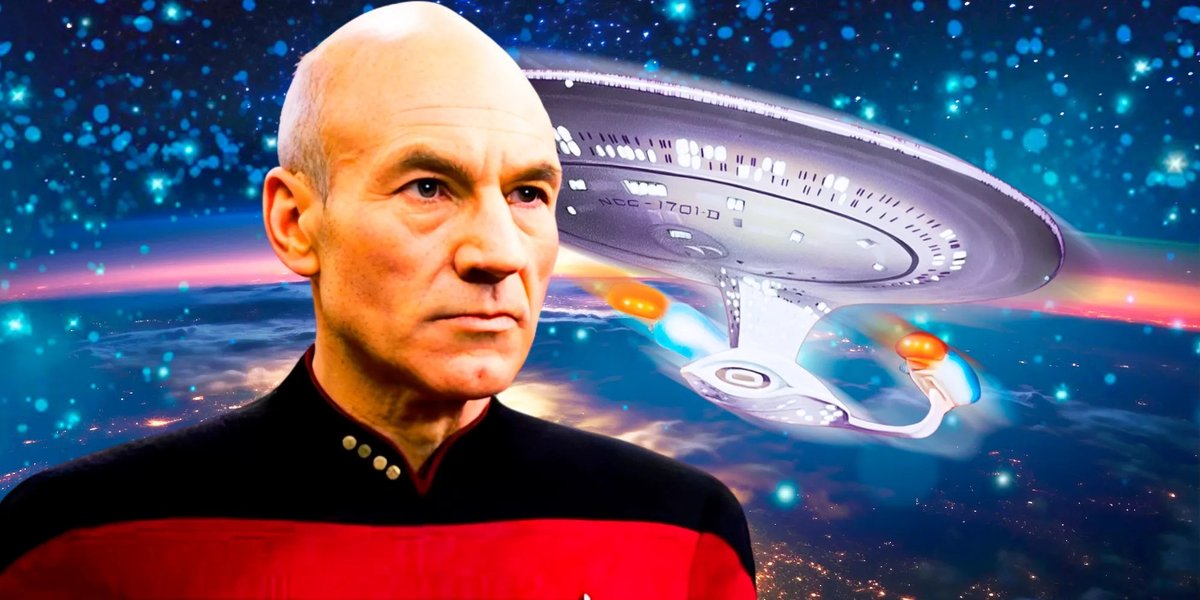
Star Trek: The Next Generation didn't just boldly go where no one had gone before; it regularly delved into the very fabric of human (and alien) existence, challenging viewers to ponder the deepest questions of philosophy. From the nature of consciousness to the ethics of artificial intelligence, from the meaning of life to the weight of our choices, TNG offered a weekly masterclass in speculative philosophy disguised as compelling sci-fi adventure.
These aren't just thrilling space battles or diplomatic standoffs; they're thought experiments brought to life, exploring concepts that have puzzled philosophers for millennia. If you've ever found yourself pausing an episode to truly consider the implications of what just happened, you're not alone. TNG mastered the art of making abstract philosophical dilemmas feel incredibly personal and urgent.
At a Glance: TNG's Philosophical Voyage
- Ponder the Nature of Being: Explore what it means to be alive, sentient, and deserving of rights, especially through the lens of artificial intelligence.
- Question Identity & Memory: Discover how TNG challenges our understanding of self, memory, and the impact of our past choices.
- Grapple with Existentialism: Confront themes of purpose, connection, and the search for meaning in an indifferent universe.
- Debate Ethics & Society: Examine complex moral dilemmas, the responsibilities of power, and the ideals of a utopian society.
- Reflect on Time & Destiny: Consider the linearity of time, the weight of alternate realities, and the legacy we leave behind.
Why TNG Still Matters: A Philosophical Compass for the Ages
Gene Roddenberry's vision for Star Trek was always about more than just spaceships and phasers. It was a vehicle for social commentary, a mirror reflecting humanity's potential and its pitfalls. While The Original Series laid the groundwork, The Next Generation – with its more mature storytelling, deeper character development, and serialized philosophical arcs – truly blossomed into a rich tapestry of ethical and existential inquiry.
TNG often presented the Federation as a utopian society, one that had seemingly overcome poverty, war, and prejudice. But beneath this polished surface, its writers consistently introduced scenarios that forced characters (and us) to re-evaluate those hard-won ideals. How do you maintain compassion in the face of absolute evil? What constitutes "life" in a universe teeming with artificial intelligence and energy beings? How do individual rights balance against the greater good? These aren't easy questions, and TNG rarely offered simple answers. Instead, it provided a framework for contemplation, inviting us into the debate rather than dictating the resolution.
The Nature of Sentience and Rights: Data's Enduring Question
Perhaps no character in Star Trek: The Next Generation embodies philosophical inquiry more profoundly than Commander Data. His very existence is a walking, talking thought experiment on the nature of consciousness, identity, and what it means to be alive.
"The Measure of a Man" (Season 2, Episode 9)
This episode isn't just a fan favorite; it's a cornerstone of science fiction philosophy. When Starfleet cyberneticist Commander Bruce Maddox arrives with a plan to disassemble Data for research to replicate him, Data refuses. This refusal sparks an impromptu judicial hearing to determine if Data is sentient and therefore has rights, or merely Starfleet property.
The arguments presented by Captain Picard (defending Data) and Commander Riker (prosecuting, against his will) are breathtaking in their depth. Picard argues that Data exhibits intelligence, self-awareness, emotions (or the desire for them), and free will. He famously compares Data's potential forced service to slavery, making a powerful case for Data's personhood.
"Your honor, Starfleet has always sought out new life. Well, there it is! Or should I say, there he is!" – Captain Picard
The episode forces viewers to confront deep ethical questions about artificial intelligence:
- What defines sentience? Is it organic biology, emotional capacity, or the ability to make choices?
- Do artificial beings deserve rights? If an AI can think, learn, and express a will, is it truly different from an organic being?
- The Slippery Slope of Dehumanization: If we deny rights to one form of intelligent life, where do we draw the line?
"The Measure of a Man" doesn't just ask these questions; it meticulously dissects them, creating a legal precedent within the Star Trek universe that resonates with real-world debates about AI ethics today. It's a powerful reminder that our legal and moral frameworks must evolve as technology advances. If you're looking for more of TNG's best, you might enjoy exploring other pivotal moments and character arcs across the entire series, including those that further flesh out Data's journey toward humanity and self-discovery. You can find many of them in our guide to the Best Star Trek TNG Episodes.
Beyond "Measure": Data's Continued Evolution
Several other episodes continue Data's philosophical journey:
- "Thine Own Self" (Season 7, Episode 16): Data experiences fragmented memories and malfunctions after being exposed to radiation, leading him to live unknowingly among a pre-warp civilization. He struggles with his identity and purpose, even without his full memories, highlighting the fundamental drive for meaning beyond external programming.
- "Elementary, Dear Data" (Season 2, Episode 3) & "Ship in a Bottle" (Season 6, Episode 15): These episodes, centered on the Holodeck character Professor Moriarty, delve into the nature of simulated reality and consciousness. If a holographic program can achieve self-awareness and desire freedom, does it too deserve rights? They extend the questions from "Measure of a Man" to even more ephemeral forms of life.
Identity, Memory, and the Self: Who Are We, Truly?
Our sense of self is deeply tied to our memories and the choices we make. TNG frequently challenged this notion, presenting scenarios that forced characters to question their own identities, the reliability of their memories, and the impact of an altered past.
"Remember Me" (Season 4, Episode 5)
Dr. Beverly Crusher finds herself in a terrifying predicament: people around her begin to disappear, one by one, with no one else on the ship recalling their existence. As her reality unravels, she confronts the terrifying prospect that her memories might be fabricating an entire crew.
This episode is a masterclass in subjective reality, memory, and the philosophical concept of solipsism – the idea that only one's own mind is sure to exist. It asks:
- How do we know what's real? If everyone else vanished, would your memories still count?
- What is the objective truth? Is reality solely based on shared consensus?
- The Fragility of Identity: If your relationships define you, what happens when those relationships cease to exist, even in memory?
"Tapestry" (Season 6, Episode 15)
In one of TNG's most beloved episodes, a near-death experience allows Captain Picard to interact with Q, who offers him a chance to revisit a pivotal moment in his youth. Picard, regretting a rash decision that led to him being stabbed through the heart, changes his past. He wakes up to a present where he is a cautious, unremarkable junior officer, rather than the celebrated captain.
This profound exploration of choices, destiny, and the formation of character asks:
- Do our mistakes make us who we are? Would removing past regrets truly lead to a better life, or diminish the person we've become?
- The Butterfly Effect: How do seemingly small decisions ripple through our lives and define our very essence?
- The Acceptance of Self: Can we embrace our past, flaws and all, as integral to our identity?
"You've grown into a man of courage and conviction. But you see, Jean-Luc, it was that insolence, that defiance, that made you who you are." – Q
"Yesterday's Enterprise" (Season 3, Episode 15)
Another fan favorite, this episode presents an alternate timeline where the Federation is locked in a desperate, losing war with the Klingon Empire because the Enterprise-C never went back in time to defend a Klingon outpost. Guinan senses the "wrongness" of this reality and helps the crew understand their mission to restore the timeline.
This episode delves into:
- The Weight of History: How one seemingly insignificant event can alter the course of entire civilizations.
- The Ethics of Intervention: Is it right to sacrifice one ship and its crew to restore a preferred timeline, even if it means erasing the lives of those in the current reality?
- Destiny vs. Free Will: Are some events predestined, or do individual choices always hold the power to change everything?
The Quest for Meaning and Connection: Existentialism in the Stars
Even in a post-scarcity future, the fundamental human questions of purpose, loneliness, and the desire for understanding persist. TNG often explored these themes, sometimes with a poignant beauty, other times with stark realism.
"The Inner Light" (Season 5, Episode 25)
Captain Picard is struck by an alien probe that implants a lifetime of memories into his mind, making him live out the full existence of Kamin, a man from a doomed planet. He experiences Kamin's marriage, children, and old age, only for the entire experience to end in moments aboard the Enterprise, leaving him with an emotional scar and a deep understanding of a lost civilization.
This episode is a powerful meditation on:
- The Meaning of Life: What constitutes a "full" life? Is it personal achievement, family, or legacy?
- Empathy and Connection: The profound experience of living another's life, and the importance of remembering lost cultures.
- Legacy and Memory: How we preserve the memory of those who are gone, and what truly matters when facing the end.
- Existential Purpose: Picard's burden of carrying Kamin's entire world, giving meaning to a people long extinct.
"Darmok" (Season 5, Episode 2)
Captain Picard attempts to communicate with Dathon, captain of the Tamarian starship, whose language consists entirely of mythological allusions and metaphors ("Darmok and Jalad at Tanagra," "Shaka, when the walls fell"). Stranded on a hostile planet, they must learn to understand each other to survive.
"Darmok" is a brilliant exploration of:
- The Philosophy of Language: How language shapes thought, culture, and our ability to connect. Can true communication occur without shared cultural context?
- Shared Experience as a Bridge: The idea that common challenges and direct experience can forge understanding where literal translation fails.
- Overcoming Alienness: The profound difficulty and ultimate reward of bridging vast cultural and linguistic divides.
"Sokath, his eyes uncovered!" – Dathon, a breakthrough in understanding.
"Encounter at Farpoint" (Season 1, Episode 1 & 2)
The series premiere immediately sets a high philosophical bar. The omnipotent entity known as Q puts humanity on trial, challenging Picard and the Enterprise crew to prove their species is no longer savage and worthy of exploring the galaxy.
This introduction to TNG grapples with:
- Humanity's Moral Progress: Have we truly evolved beyond our darker impulses, or is our utopian future merely a veneer?
- The Right to Exist/Explore: Who gets to decide which species are worthy of advanced capabilities or galactic expansion?
- Judgment and Mercy: Q acts as both accuser and judge, forcing humanity to confront its own history and potential.
Power, Morality, and the Collective: Society's Toughest Choices
Even in a seemingly enlightened future, the dynamics of power, the complexities of morality, and the tension between individual liberty and collective good remain potent sources of conflict and philosophical debate.
"The Best of Both Worlds" (Season 3, Episode 26 & Season 4, Episode 1)
This two-part epic is arguably TNG's most iconic storyline. Captain Picard is assimilated by the Borg, transforming him into Locutus of Borg, an emissary for the collective. The Federation faces its most formidable enemy, one that seeks not conquest, but assimilation, where individuality is sacrificed for perfect unity.
This terrifying encounter forces consideration of:
- Individuality vs. Collectivism: Is there value in individual thought and freedom if it leads to inefficiency and conflict? Is absolute unity a form of dystopia or ultimate evolution?
- The Ethics of Resistance: How far do you go to fight an enemy that defines your existence as irrelevant? Can you "kill" someone you once knew to save billions?
- The Nature of Power: The Borg represent a terrifying form of power—not just military might, but the power to absorb, erase, and transform.
"Q Who" (Season 2, Episode 16)
Before "Best of Both Worlds," Q gives humanity a taste of the truly unknown by flinging the Enterprise into uncharted space, directly into the path of the Borg. His intention is to show Picard that humanity is arrogant and unprepared for the vast dangers of the galaxy.
This episode explores:
- Humility in the Face of the Unknown: The Federation's confidence is shattered, forcing them to reconsider their place in the universe.
- The Limits of Preparedness: Can a society ever be truly ready for every existential threat?
- The Morality of Divine Intervention: Even if Q's methods are harsh, does he have a point about humanity's naivety?
"The Drumhead" (Season 4, Episode 21)
Following an explosion, an investigation into potential sabotage escalates into a witch hunt. Admiral Satie, a revered judicial figure, begins to accuse innocent crew members of conspiracy, using fear and xenophobia to justify her expanding power.
This episode is a chilling examination of:
- The Dangers of Paranoia and Fear: How quickly a pursuit of justice can devolve into McCarthyism and oppression.
- Protecting Civil Liberties: The critical importance of due process, privacy, and fundamental rights, even in times of crisis.
- The Corruption of Power: How even those who begin with noble intentions can become consumed by the authority they wield.
"The Chase" (Season 6, Episode 20)
This episode features Picard leading a multi-species chase across the galaxy to decipher an ancient genetic program. The discovery reveals a common humanoid progenitor race that seeded DNA throughout the galaxy, leaving a message for all their descendants.
This unique narrative raises questions of:
- Anthropocentrism: The assumption that humanity (or any single species) is uniquely special. This episode reveals a shared origin for many species, fundamentally challenging that view.
- The Desire for Legacy: The progenitors' motivation to leave behind a living memory, reflecting a universal desire for meaning beyond one's own lifespan.
- Shared Heritage and Unity: The implications of discovering that various warring species are, in fact, "family."
"There is something of us in each of you, and so, something of you in each other. Remember us." – The Progenitor
Time, Destiny, and the Infinite: Beyond the Horizon
TNG often played with the concept of time, not just as a linear progression, but as a malleable force that shapes destiny and offers opportunities for reflection on life's path.
"All Good Things..." (Season 7, Episode 25 & 26)
The series finale sees Q once again testing Picard, but this time across three different time periods: his present, seven years in the past (before the Enterprise-D), and twenty-five years in the future. Picard must solve a paradox that threatens to erase humanity from existence.
This ambitious finale explores:
- The Non-Linearity of Time: How past, present, and future are interconnected and influence each other.
- Acceptance of the Unknown: Picard's growth from someone needing answers to embracing ambiguity and the journey itself.
- The Legacy of a Life: Picard looks back on his life and forward to his future, contemplating the meaning of his journey and relationships.
- Humanity's Ongoing Evolution: Q's final test suggests that growth and learning are endless, an eternal challenge.
"Relics" (Season 6, Episode 4)
The Enterprise discovers Montgomery Scott, chief engineer of the original Enterprise, trapped in a transporter buffer for 75 years. He struggles to adapt to the 24th century, feeling obsolete and out of place.
This poignant episode touches on:
- Aging and Obsolescence: The challenge of finding purpose and relevance when technology and society have left you behind.
- The Nature of Heroes: Scotty, a legend, confronts his own mortality and the reality that time marches on.
- Legacy and Respect: The way newer generations honor and learn from those who came before them.
Your Next Mission: Exploring TNG's Philosophical Depths
These episodes are more than just entertainment; they're invitations to engage with profound philosophical questions that remain relevant today. Whether you're a long-time Trekkie or a newcomer curious about the show's intellectual depth, rewatching these TNG episodes with a philosophical lens can be a truly enriching experience.
Grab your favorite beverage, settle in, and prepare to not just watch, but think. Discuss these themes with friends, ponder them in your own quiet moments, and let the crew of the Enterprise-D continue to guide you on a journey of discovery—not just of new worlds, but of new ideas within yourself.