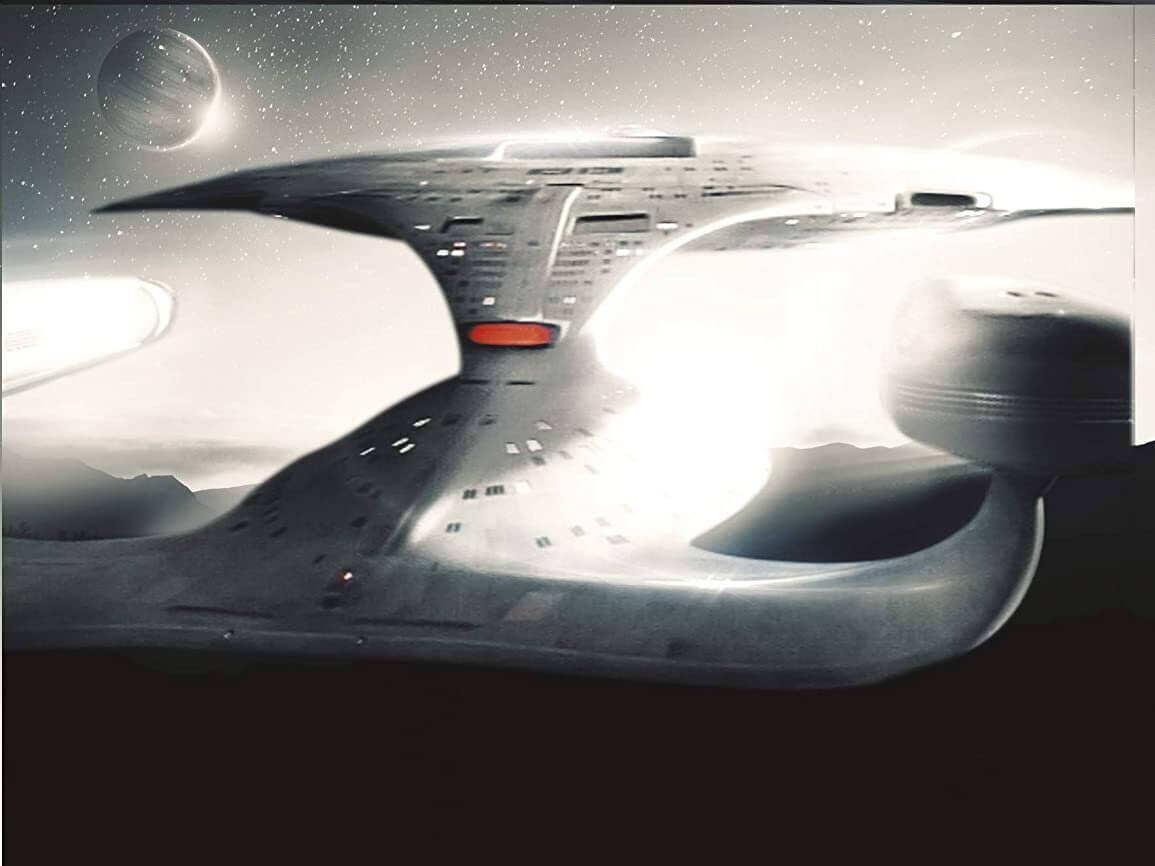
When Captain Jean-Luc Picard first uttered "Engage!" aboard the USS Enterprise (NCC-1701-D) in 1987, a new era of Star Trek began. Building on Gene Roddenberry's enduring vision, Star Trek: The Next Generation (TNG) not only became a worthy successor to The Original Series but solidified its place as one of the greatest science fiction shows of all time. Across seven seasons and 178 unforgettable episodes, the series captivated audiences, garnered 19 Emmy Awards, and left an indelible mark on popular culture by exploring complex moral dilemmas, technological marvels, and the very essence of humanity.
TNG introduced us to an iconic crew: the thoughtful Captain Picard (Patrick Stewart), the adventurous Commander Riker (Jonathan Frakes), the brilliant android Data (Brent Spiner), the intuitive Counselor Troi (Marina Sirtis), the loyal Worf (Michael Dorn), the resourceful Geordi La Forge (LeVar Burton), and the compassionate Dr. Beverly Crusher (Gates McFadden). Together, they journeyed through the cosmos, encountering new civilizations and pushing the boundaries of what it means to be human in an infinite universe.
Charting the Galaxy: Why TNG Endures
TNG's enduring appeal lies in its masterful blend of intelligent storytelling, compelling characters, and a hopeful yet challenging view of the future. Each episode often served as a philosophical inquiry, a character study, or a grand adventure, cementing its legacy not just as entertainment but as a cultural touchstone. For newcomers and seasoned fans alike, navigating the vastness of TNG's episodic galaxy can be a daunting, albeit rewarding, task.
This flagship hub is designed to be your ultimate guide, steering you through the finest moments of Starfleet's most celebrated vessel. From heart-wrenching emotional journeys to epic confrontations and groundbreaking lore, we've organized the series' most impactful episodes into distinct categories, ensuring you can easily See TNGs absolute best and dive deeper into what makes them truly special.
The Pinnacles of Perfection: Episodes Everyone Must See
Certain TNG episodes transcend typical television, becoming cinematic events that define an era. These are the stories that cemented TNG's reputation, offering unparalleled drama, character development, and stakes that reverberated across the franchise. You're likely thinking of "The Best of Both Worlds," the thrilling two-part season finale that saw Captain Picard assimilated by the Borg into Locutus, forcing Riker to make an impossible choice that shook the Enterprise to its core. This storyline perfectly showcased the crew's autonomy and Picard's vulnerability, setting a new benchmark for serialized science fiction.
Equally renowned is "The Inner Light," a Hugo Award-winning masterpiece where Picard lives an entire lifetime on a dying planet within a mere 25 minutes. This poignant narrative profoundly explores memory, legacy, and what it means to truly live, leaving Picard with a haunting gift: a flute that plays the music of a lost world. These episodes, alongside pivotal entries like "Yesterday’s Enterprise," which bravely brought back Tasha Yar in a darker, war-torn timeline, and the spectacular series finale "All Good Things…," which saw Picard traversing three timelines to explore humanity's potential, represent the very peak of TNG's storytelling prowess.
Forging Identities: Episodes That Defined Our Beloved Crew
While the Enterprise's voyages were filled with galactic spectacle, it was the deep, nuanced development of its characters that truly made TNG resonate. Episodes frequently delved into the personal journeys, ethical quandaries, and inner strengths of the main cast, solidifying their place in our hearts. Consider "The Measure of a Man," a pivotal Season 2 episode where Data must fight for his right to self-determination against a Starfleet official who sees him as mere property. Picard's passionate argument for Data's personhood affirmed the very liberal principles upon which the Federation was founded. This scene, often featuring a crew poker game, was an early highlight for Data's character.
Jonathan Frakes' directorial debut, "The Offspring," further explored Data's quest to understand human behavior when he creates his "child," Lal. Her tragic, brief life underscored the franchise's profound concept of humanity and self-determination. Dr. Beverly Crusher's logical mind and inner strength were put to the test in "Remember Me," as crewmates mysteriously vanished around her, forcing her to confront a terrifying reality. Even Worf received nuanced attention in episodes like "A Fistful of Datas," a holodeck Western romp that smartly avoided common criticisms of his character. To explore these intricate character arcs and more, you'll want to dive into Character-Defining Star Trek: TNG Episodes.
Probing the Human Condition: TNG's Philosophical Journeys
Beyond action and adventure, Star Trek: The Next Generation consistently pushed boundaries by tackling profound philosophical questions and ethical dilemmas. The series excelled at using alien encounters and advanced technology to hold a mirror up to human nature, exploring concepts of identity, morality, and understanding across cultures. Perhaps no episode better exemplifies this than "Darmok," where Picard is stranded on a planet with a Tamarian alien who communicates only through allegory. Their struggle to bridge a seemingly insurmountable language barrier is a powerful testament to Star Trek's commitment to communication and mutual understanding, symbolized by the legendary "Darmok and Jalad at Tanagra."
Similarly, "I, Borg" presented a staggering ethical dilemma when a lone Borg drone, Hugh, became separated from the collective. The Enterprise crew grappled with the moral choice: use Hugh as a biological weapon to destroy the Borg, or respect his nascent individuality. This story profoundly explored the nature of humanity, selfhood, and the potential for rehabilitation even in the most formidable foes. Other episodes, like "The Chase," saw Picard leading a race against other species for ancient technology that revealed a surprising common origin of life for many alien races, reinforcing Star Trek's central themes of connection. For deeper dives into these thought-provoking narratives, check out Star Trek: TNG Episodes That.
Confronting the Darkness: Iconic Villains and Moral Ambiguity
The vastness of space inevitably brings encounters with formidable adversaries, and TNG introduced some of the most memorable villains in science fiction history. The Borg, of course, stand paramount, embodying a terrifying force of assimilation and challenging the very notion of individuality. Their relentless pursuit in "The Best of Both Worlds" and their later, more complex portrayal in "I, Borg" proved them to be more than just a simple monster-of-the-week. Then there’s the enigmatic Q, a god-like being from the Q continuum who frequently challenged Picard's leadership and humanity, often with a mischievous flair, as seen in "Qpid," where he hilariously transforms the bridge crew into Robin Hood characters to "help" Picard.
The series also masterfully introduced the Cardassians in "The Wounded," providing a nuanced look at a defeated empire struggling with the fallout of war. This episode notably developed Chief Miles O’Brien's character and set the stage for the morally complex narratives that would define Deep Space Nine. The two-part "Chain of Command" pushed Picard to his breaking point, enduring psychological torture at the hands of Gul Madred, a Cardassian, in a powerful exploration of duty and truth. For a complete look at these compelling antagonists and the complex conflicts they instigated, you'll want to Discover TNGs most iconic villains.
Shifting Paradigms: Game-Changing Lore and Universe Expansion
Star Trek: The Next Generation wasn't afraid to innovate, introducing concepts and characters that fundamentally reshaped the Star Trek universe and paved the way for future series. Episodes often served as crucial building blocks, expanding the known galaxy and offering new perspectives on the Federation itself. "The Wounded," as mentioned, was instrumental in introducing the Cardassians, a race whose intricate politics and conflict with the Federation would become a cornerstone of Deep Space Nine. Similarly, "Preemptive Strike" featured Ro Laren joining the Maquis, directly leading into vital storylines for the subsequent spin-off.
Other episodes expanded the very fabric of time and space, like "Cause and Effect," where the Enterprise is repeatedly destroyed in a time loop, culminating in a surprising reveal involving a TOS-era starship. "Relics" provided a delightful crossover moment, bringing the beloved Montgomery Scott from The Original Series into the TNG era, showcasing genuine chemistry with Geordi La Forge and even recreating the TOS bridge. And of course, "Lower Decks" offered a groundbreaking look at the lives of junior officers, providing a "red shirt" perspective that was so popular it eventually inspired its own animated series. To understand how these pivotal stories altered the landscape of the galaxy, explore Game-Changing & Lore-Expanding Star Trek.
Engage! A Continuing Legacy
From its groundbreaking philosophical explorations to its unforgettable characters and epic storylines, Star Trek: The Next Generation remains a cornerstone of science fiction. It's a series that continues to inspire, challenge, and entertain, proving that the final frontier isn't just about space, but about the endless possibilities of the human (and synthetic, and alien) experience. Whether you're revisiting old favorites or discovering these gems for the first time, the journey aboard the Enterprise-D promises adventure, wisdom, and a profound appreciation for the power of storytelling.